
Free 5G Government Phones: Lifeline, Providers and Compatibility

Fast, reliable 5G is essential for work, online classes, healthcare, and staying connected. Yet for many Americans, the cost of a modern smartphone puts that connection out of reach.
Lifeline can reduce the cost of qualifying phone or internet service. Participating providers may separately offer promotional phones, but a 5G-capable handset is not guaranteed. Availability depends on the provider, location, current promotion, device compatibility, and inventory.
This guide explains how to check Lifeline eligibility, verify current provider availability, and distinguish 5G network access from a specific handset offer.
What Is a Free 5G Government Phone?
The phrase free 5G government phone usually refers to a participating provider’s device promotion connected with Lifeline service. Lifeline itself is a service discount; it does not guarantee that every qualifying household receives a free 5G phone or a particular model.
Why 5G Matters for Low-Income Households
5G networks offer:
- 10–100× faster speeds than 4G LTE.
- Ultra-low latency for real-time services like telehealth and job interviews.
- Better network capacity to handle more devices without slowdown.
- Future-ready performance for streaming, video calls, and advanced apps.
Key Benefits of 5G Over 4G
- Seamless video conferencing and remote learning.
- Faster downloads and app updates.
- Stable connections in crowded areas.
- Improved access to online job applications and healthcare portals.
Lifeline, 5G Service, and Device Offers
Lifeline Assistance Program
The federal Lifeline Program provides a monthly discount on qualifying phone or internet service. A participating wireless provider may include 5G network access, BYOD support, or a promotional phone, but plan features and device terms vary by provider and location.
Contact Information:
- Website: www.lifelinesupport.org
- Phone: 1-800-234-9473 (Mon–Sun, 9 a.m.–9 p.m. ET)
- Email: LifelineSupport@usac.org
Who Qualifies for Lifeline
You may qualify if:
- Your household income is at or below 135% of the Federal Poverty Guidelines
- You participate in programs like Medicaid, SNAP, SSI, Federal Public Housing Assistance, Veterans Pension, or Tribal assistance programs.
Income-based eligibility
Income-based Lifeline eligibility uses 135% of the Federal Poverty Guidelines. The dollar limits depend on household size and location and are updated over time, so verify the current amounts on the official Lifeline Support qualification page rather than relying on an old annual table.
Program-based eligibility can also include SNAP, Medicaid, SSI, Federal Public Housing Assistance, the Veterans Pension and Survivors Benefit, and certain Tribal programs. Learn more in our Lifeline eligibility documents guide and verify current rules with Lifeline Support.
Former Affordable Connectivity Program (ACP)
The Affordable Connectivity Program (ACP) ended on June 1, 2024 and is not accepting enrollments. Lifeline is a separate, continuing federal program. Current 5G service or device offers should be verified directly with a participating Lifeline provider.
State and Local Availability Can Differ
Some states have their own Lifeline application processes or additional telecommunications-assistance rules. Provider participation, network coverage, plan features, and device promotions can also differ by ZIP code. Verify the current process with the relevant state program and the provider serving your address.
How to Verify Current 5G Provider Options
Start with the official Lifeline company finder or a provider that serves your ZIP code. Then check the provider’s current plan, network coverage, BYOD compatibility, and device terms. For example, Assurance Wireless currently supports compatible BYOD devices, while SafeLink states that a 4G LTE or 5G-capable device is required and that offers vary by state. A current provider listing does not guarantee a free 5G handset.
5G Phone Models and Compatibility
Provider inventory changes, so avoid assuming that an iPhone, Samsung, Pixel, Motorola, or any other specific model will be available for $0. To use 5G service, the phone must support the provider’s network and 5G coverage must be available where you use it.
Before enrolling, check the exact device and price shown by the provider, verify BYOD compatibility if you already own an unlocked 5G phone, and confirm 5G coverage at your location. For broader device-selection context, see our government phone models guide.
How to Check Eligibility and Continue Through Official Channels
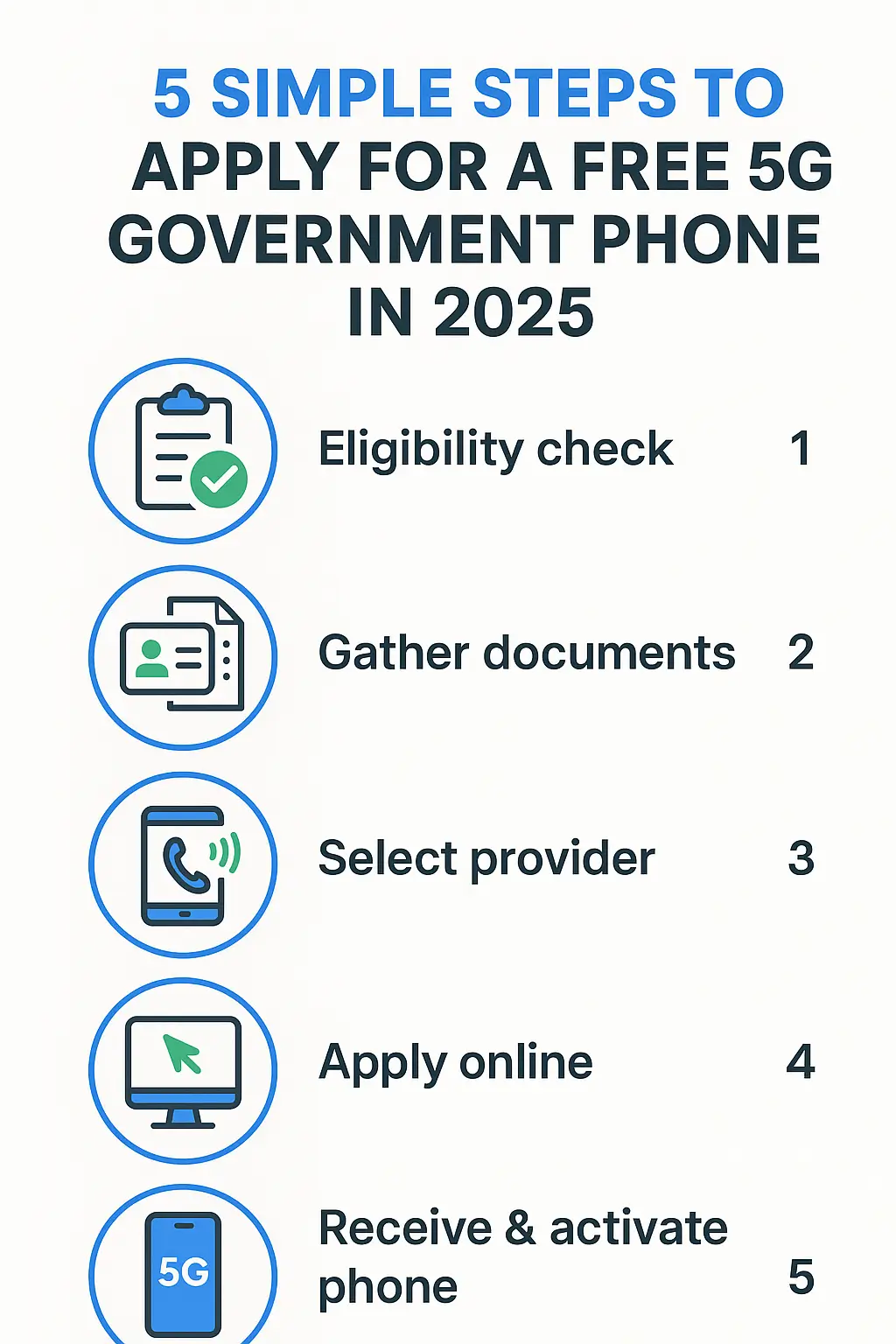
Step 1: Check Eligibility
Use the National Verifier or your state’s Lifeline site.
Step 2: Review any document request
If eligibility cannot be verified automatically, the official process may request identity, program-participation, income, address, or household documentation. Submit sensitive documents only through an official Lifeline process or directly to a provider you have independently verified.
Step 3: Choose a participating provider
Compare coverage, plan terms, BYOD compatibility, and any current device promotion for your ZIP code.
Step 4: Complete the official/provider enrollment steps
Continue through the official Lifeline process and the participating provider’s enrollment channel. ApplyFreeGovPhone.com does not approve eligibility, process enrollment, or ship devices.
Step 5: Activate service or a provider-supplied device, if applicable
Activation and any device shipment are provider-specific. There is no universal 3–7 business-day delivery promise.
Tips to reduce avoidable delays
Use accurate information, respond to official document requests promptly, verify provider availability for your ZIP code, and review the exact device terms before enrolling. Applying earlier does not guarantee a premium or high-demand phone model.
Common Myths About Free 5G Phones
Myth: Every Lifeline customer receives an old 4G phone.
Reality: Device offers vary. Some providers support 5G service or 5G-capable devices, while others may emphasize BYOD or lower-cost phones. Verify the exact offer for your location.
Myth: Every website advertising a government phone is an official enrollment site.
Reality: Verify eligibility through official Lifeline channels and use the official company finder or a provider you have independently verified.
Myth: You can get multiple free phones per household.
Truth: Only one benefit per household is allowed, but separate financial households at the same address may qualify individually.
FAQs
Can I upgrade to a better 5G phone?
Yes, some providers offer upgrades for a small one-time fee.
Do all states offer free 5G phones?
Lifeline is available nationwide, but participating providers, plan features, network coverage, and device promotions vary by state and service area.
Can seniors get free 5G phones?
Yes, if they meet the income or program requirements.
Which carriers have the best 5G coverage?
There is no single best 5G carrier for every address. Compare the participating provider’s actual coverage at your location and confirm that your phone supports the relevant network.
What if I lose my free phone?
Contact your provider immediately; replacement rules vary.
How long does approval take?
There is no universal approval timeframe. Automated eligibility checks may be quick, while document review, state-specific processes, or provider enrollment can take longer.
Conclusion!
Lifeline remains a continuing federal service-discount program. If you want 5G service, verify both network coverage and device compatibility, then review the participating provider’s current plan and device terms for your location.
Start by reviewing current eligibility information through Lifeline Support and then compare participating providers serving your area. A specific free 5G model is not guaranteed by Lifeline or by ApplyFreeGovPhone.com.


